"It is not the strongest of the species that survive, nor the most intelligent, but the one most responsive to change!" - Charles Darwin
Showing posts with label Team. Show all posts

Monday, 3 July 2017

3 signs your daily Scrum sucks (and how to cure them)


It is actually a long time I have not written an educational article on Scrum. 
I have recently found some notes from a conversation I had with a community of Scrum Masters few months ago and decided to package them into a blog post. Hope you appreciate it.

So here are three small and easy to observe signs that you need to fix your Daily Scrum.

1. People are only interested in their own tasks.
I found that this behavior is also pretty encouraged by the common way of running the Daily Scrum, i.e. the famous three questions. I found many times that people normally follow with attention until it is their turn to speak; they simply disconnect after that.
When I see this, I normally propose the team to try a different way of handling the stand-up.
One way that works is to keep the same 3 questions, but have 3 rounds instead of one, with each person answering only one question at a time. 
This usually gives two benefits. 
The first of course is to keep people actively engaged until the end, since they know they will have to speak again. 
But there’s a more important one. It serves better the real purpose of the Daily Scrum of collectively assessing where the team is compared to the Sprint goal and collaboratively deciding what the next most important task is for each team member to complete, in order to move closer to the Sprint goal.
Another way (which brings even more benefits in my experience) is to run the stand-up not focusing on people’s tasks, but on User Stories. 
The idea is that the team takes one User Story at a time from the top and discuss about how to make it “done done” as soon as possible. Then you take the next and move on, either until you covered all the opened stories or until the 15-minutes time is up. In that way team members do not focus on the individual tasks, but more directly look at the Sprint goal as a collective goal to achieve. Sometimes you do not manage to talk about lower priority stories, so people who are working on those feel a bit excluded J. That provides some social pressure to contribute to complete the highest priority stories first, instead of minding their own tasks.
2. Everybody is looking at the Scrum Master instead of at each other
Sometimes it feels more like a status report. So I use the trick to encourage them to stay in circle, closer to the task board, and I take (or ask the Scrum Master to take) a step back, pretending I’m taking notes. I avoid looking at them in the eyes, so that they feel a bit uncomfortable and they are forced to find other eyes to look into: their team mate’s eyes. It works immediately most times.
I use the same trick also when they tend to look at their manager attending the Daily Scrum: I encourage them to stay in circle, leaving all other attendees outside.
3. People tend to have long discussions, trying to fix problems during the stand-up
I know that many Scrum Masters tend to interrupt discussions or ask people to continue discussion outside the meeting. This works some times, but many times I found that a bit irritating. I try to use and teach a different approach.
I normally try to explain at the beginning very clearly to the team that the Daily Scrum is intended for the Daily Planning, so that everybody understands and buy into this . So, when I see that a discussion is going on, I leave room for a couple of minute. If it is not concluded yet, I ask a question like: How do you think this can affect today’s planning? Most times people admit that it is not strictly relevant and propose to park it.
On top of that, in order to have the team really self-organize, because it is everyone’s responsibility to keep the time of the Daily Scrum, I always use a timer (a digital one or a “pomodoro”) to visualize the time passing and signal when it is up, so that the Scrum Master does not act as the bad time-keeper guy.
Of course the three above and other dysfunctions might be just a symptom of something deeper. 
If the techniques illustrated above do not work, it can be a smell of something more important that must be addressed.

What are the dysfunctions in your Daily Scrum?

Saturday, 20 May 2017

The 21st century´s paradigm to connect people and work to be done

Few days ago I had a phone call with a friend of mine. During our conversation she shared with me one of the challenges she is facing at work and wanted to check what I might think about.
Basically they have few issues when it comes to allocating people to work on a project they sold to a customer.

The challenges are multi-faceted:     
  • Finding people with the competences which fit that specific project
  • Finding people who are available to work on that project
  • Finding people who are willing to work on that specific project

Now the sweet point would be: a reasonable amount of people with the right competences, who are available at that time and willing to take on the project.

Very hard! Almost impossible! So what is usually the second best option?
Right! Put together on the project just who is available at that moment in time and hope it will not turn out too bad until someone with the right expertise can join and save the boat.

Does it sound familiar? I am sure it does, if we live in the same world.

But I have a second question: any guess what my friend’s job is?
Well, if you are thinking about anything among Project Manager, Development Manager or SW developer, you got it wrong. 
She is an architect: not a SW architect, a “real” architect.

If the fact that an architecture office might have similar problems to any product development company sounds unexpected to you, you have not considered the fact that the nature of the work is substantially the same in both fields: solving new problems which have undefined boundaries and multiple possible solutions within a complex environment where multiple entities influence each other in unpredictable ways.
To me this is just another confirmation of a pattern that I have seen in all organizations coping with work of such a nature and trying to apply traditional patterns to solve this challenge in the current century.

Can the situation be slightly improved by applying those patterns more efficiently? Probably yes and the PMI might have few ideas around that.
However my experience tells me that the problem cannot be solved if we do not embrace the fact that a totally different paradigm is needed.

Why?

  • Customer requests are more and more unclear: they do not know what they want. Problems are wicked: there is no pre-defined answer
  • Market is becoming more volatile: new and unexpected needs are emerging which require flexibility in companies
  • Professions are more and more specialized. Too many individuals I-shaped skills, which means they have deep knowledge and experience in just one area
  • Work is done in silos: lack of holistic view by individuals, but also knowledge domain in many professions is so big that is impossible for a single person to know-it-all
  • Having parallel projects competing for human resources is not sustainable anymore in the above context
  • Having people working on multiple projects reduces their effectiveness and productivity: context switching makes people waste time and produces stress, which can reduce IQ by 20%

So what is this different paradigm all about?

  • Understand the flow of value you create and setup stable, 100% focused, self-organized teams with a shared goal around your value flow
  • Bring highest value work to teams instead of allocating (or multi-allocating) people to work
    • Having the team as the atomic element simplifies allocation very much
  • Focusing on getting the most important thing out as fast as possible instead of focusing on making people busy (flow efficiency over resource efficiency)
  • Teams must be cross-functional: they must have all the competence needed to get work done
  • The holistic view of the work is kept at team level
  • Move from I-shaped individuals to T-shaped or even X-shaped professional who can do more things, so that you can have smaller teams with all needed competences
    • This can be partly achieved through synergies in teams, but also having the expert teaching to the others, to reduce the bus factor

Dare to take the journey? Do you have enough courage to address your own problems?

*In her book “Mindset”, Carol Dweck talks about the following concept: if you take two people, one of them is a learn-it-all and the other one is a know-it-all, the learn-it-all will always trump the know-it-all in the long run. See also what Microsoft CEO Satya Nadella said in an interview last year about his effort to overhaul the company culture.

Monday, 30 December 2013

What the hell is a Sprint Review?

This is the last post before New Year’s Eve: so it is time to “review” the year which is going to give us the gift of enjoying the last days in its last month. That’s why I decided to spend few lines about Sprint Review.
2013 has been for this blog quite an interesting journey of 22 articles: I learned a lot by publishing them and I hope the 9000 readers (R)Evolutionary Agility had in the last 2 years have learned something as well. I wish you all an exciting and joyful 2014!


Some weeks ago I delivered a 3-days course for Scrum Masters. I usually visualize the agenda as a backlog of subjects we prioritize together throughout the training.

During a coffee break a guy approached me and asked: “I recognize the different ceremonies in the agenda, but I never heard about Sprint Review. We normally do a Sprint Demo: is it the same thing?”
“It depends on what you do in your Sprint Demo. Can you tell me more?”, I answered.
“Well, at the end of the iteration our Program Manager calls for a Demo meeting. All Scrum Masters are attending and reporting what we have been doing during the past 3 weeks”.
“So what are you demoing then?, I asked.
“We’re presenting a powerpoint slide set, showing a detailed report of the different activities during the Sprint, who was doing what and how much time was spent given the people allocation”.

Again? Yet another manipulated buzzword!?
And yet another empirical evidence of how an organization can produce so powerful antibodies to resist and protect itself from cultural change bacteria.

So let’s see if we manage to inject some virus of learning and growing mindset: these are usually quite effective in spreading willingness for improvement.

Let’s start from some why: why is a Sprint Review important? What is the purpose it is meant to serve?
Scrum is grounded in empirical process control theory and therefore uses an iterative and incremental approach to optimize the path towards a certain business goal by means of fast feedback loops. 
As any other implementation of empirical process control, it is based on 3 pillars:

  1. Transparency
All information necessary to handle the process must be available to those handling the process

  1. Inspection
The different aspects of the work must be inspected frequently enough so that unacceptable variances can be detected. Of course the skill and diligence of the people inspecting the work resul matter.

  1. Adaptation
If the inspector determines from the inspection that one or more aspects of the process and the resulting product are unacceptable, the inspector must adjust the process or the material being processed. The adjustment must be made as quickly as possible to minimize further deviation.
The Sprint Review meetings are used to inspect progress toward the Release Goal and to make adaptations that optimize the value of the next Sprint.

The Sprint Review is then an important learning point and a fundamental step in the empirical process control applied by Scrum. That’s why calling it just “demo” is mislabel, since this word does not capture the real intent of this ceremony. Let’s analyze what might be the learning points for the main actors:


  • The Product Owner and key stake-holders learn what is going on with the product, what are the results of the Sprint and check whether those results are able to bring the whole Scrum Team closer to the Product Vision. The Sprint result will have anyway impact on the Product Backlog for the next Sprint Planning: new stories might be added, changed or removed and prioritization might change.
  • The Development Team learns what is going on with the Product Owner and the market. They also learn whether the Sprint Result validated the assumptions they made during the Sprint Planning. For that reason it might be useful to review the estimates, to check whether they got confirmed after the story was actually built: in this way the team know how to estimate better and build a better baseline to relate further estimations. They’d better review also the different team metrics and the Sprint Burndown Chart to gather interesting data for the coming Sprint Retrospective. Review of Team Working Agreements and Definition of Done will indicate the team whether what they learned during the Sprint can affect the team’s rules or their quality criteria.
For these reasons, the most important element of the Review is the conversation and collaboration between the Team and Product Owner to learn the situation, to get advice, and so forth.
It is a public ceremony: the Product Owner, Team members, the ScrumMaster, plus customers, stakeholders, experts, managers and anyone else interested is allowed to attend and anyone present is free to ask questions and give input. The Scrum Master will work to maximize the learning of all participants.

Even though calling the Review just “demo” doesn’t really make the point, the demo is anyway an important part of it. But what does it make sense to demo?

Let’s have a look at some of the Principles in the Agile Manifesto:

1) Our highest priority is to satisfy the customer through early and continuous delivery of valuable software

3) Deliver working software frequently, from a couple of weeks to a couple of months, with a preference to the shorter timescale.

7) Working software is the primary measure of progress.

It doesn’t mention powerpoint slides, right? J
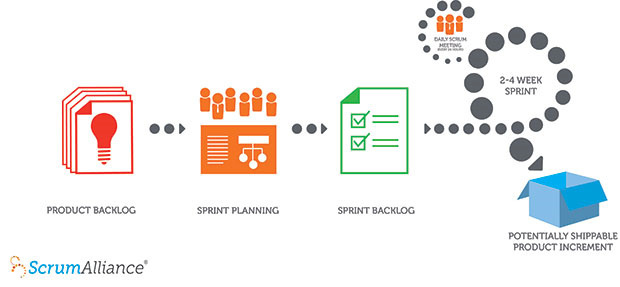
So the only demo which makes sense is showing an installation of an integrated potentially shippable product increment. BTW, the Product is the only language which everybody, from business to developers will understand the same way.
Remind: spend as little time as possible on preparing for the demo. If you need to spend a lot of time there must be something wrong somewhere.

If you read and liked this article, I have a question for you: 
How will you change your next Sprint Review?

Friday, 26 October 2012

Bootstrapping a successful Agile Team


When starting up a new Scrum team, you cannot assume that the team starts sprinting right away. 
Setting the foundation for the team success is key! 
Lyssa Adkins very well says in her book Coaching Agile Teams that basically a new Agile team needs to learn 3 things:

  • Learn about the Process (for instance the Scrum framework)
  • Learn about the Team itself (starting from learning about one another as human beings and then setting the stage for self-organization and cross-functional behavior)
  • Learn about the Product to build (i.e. learning about the work ahead) 
But how can an Agile coach make the team learn that?
I normally take inspiration from an interesting story from 17th century to help the team learn in an organic way: the story of the Hudson's Bay Company created by England's King Charles II in 1670.


This company was (and is still today) in the fur selling business: they provided supplies for the hunters who went to the North Canada to hunt bears or foxes and bought animals back from them to sell furs. After a while they realized their business was affected by a lot of hunters dying because they forgot essential supplies. Then in 1874 they developed a practice they called Hudson's Bay Start.

They provisioned the expedition with the necessary supplies. Then they sent the expedition team a short distance in their canoes to camp overnight. This was a test, very necessary so that, before finally launching into the unknown, one could see that nothing has been forgotten or that, if one had taken too much, being so near to the base, the mistake could be easily corrected.
In this part of Canada having the right supplies in the correct amounts was literally a matter of survival!

As I said, I take inspiration from this story and normally organize a Hudson's Bay Start for every newly formed Scrum team with a number of goals: 
  • remove the first impediments to start
  • check the development environment
  • start building the team
  • buy time to groom the Product Backlog 
  • practice Scrum with a "safe failure" approach. 

Therefore I ask to build a fake application (a bowling game tracker, for instance, but you can find many ideas at http://codingdojo.org/cgi-bin/wiki.pl?KataCatalogue) in order to get the team away from the daily work and take them into a creative environment to let them learn faster and have fun.

When you start something completely new it is better to go out of your usual context, so that people are put on the same level (regardless their starting point) and thus are not afraid to experiment and challenge themselves.
The fake application creates the safe failure environment to practice Scrum, but it must be implemented in the real system and developed by using the actual tools, so that the development environment can be checked by really trying it out.
With a Hudson Bay start, you're less interested in the actual product and more interested in making sure the development and deployment process works.

One could ask: Why are you spending precious team time to build a fake application? Don't you have shipping deadlines to meet?
Of course we have, but it is also a matter of reducing risk.

The Hudson's Bay Start was not free for the Hudson's Bay Company either.
But the alternative for the hunters was dying in the wild!